The Athlete Performance & Physique Blueprint
As an athlete, you have probably tried to improve your body composition at some point.
Sometimes you make progress, but you notice that training quality and recovery take a hit.
Other times you increase intake so you feel better in sessions, but you don’t like what happens to your physique.
Over time, it can start to feel like you have to choose one goal and accept a trade-off with the other.
In this article, I want to outline a framework that can help you reduce body fat while keeping performance on track and, in some cases, even improve performance during a fat-loss phase.
The Performance & Physique Balance
To improve body composition, you typically need to be in an energy (calorie) deficit.
But, all else equal, if you provide less energy to the body, there will be less available to support training, recovery, and day-to-day demands, which can reduce performance.
The key phrase here is “all else equal.”
When people struggle, it is often because the only change they made was eating less, while the rest of their nutrition stayed the same.
But consider a scenario where during that same fat-loss phase, you:
increased protein to an adequate level (supporting recovery and muscle retention)
improved your pre-training meal (improving fuelling for each session)
increased fibre (improving overall health markers)
I’m sure you’ll agree that you’d be likely to at least see less of a performance downturn than if you focussed only on cutting down your calorie intake.
And that’s just three examples of performance-enhancing nutrition strategies.
That leads us to the question:
While going into a calorie deficit, can you implement enough performance-enhancing nutritional strategies to offset the potential downside of the calorie deficit?
In my experience, the answer is yes.
In fact, I’ve seen it many times with athletes I work with that we can get it to the point where we’re not only maintaining performance in a fat-loss phase, but we’re actually improving it.
To make this more visual and drive home the point, imagine a balancing scale or a see-saw.

On one side is the calorie deficit.
On the other side is your performance-enhancing nutritional strategies.
Let’s say (for easy maths), the deficit creates 5% performance hit, weighing down that side of the see-saw.
But let’s also say that you add 5-10 performance-enhancing strategies to the other side, each of them bringing a 1% performance improvement.
Suddenly the balance starts to shift back towards level, and could even shift towards performance improvements.
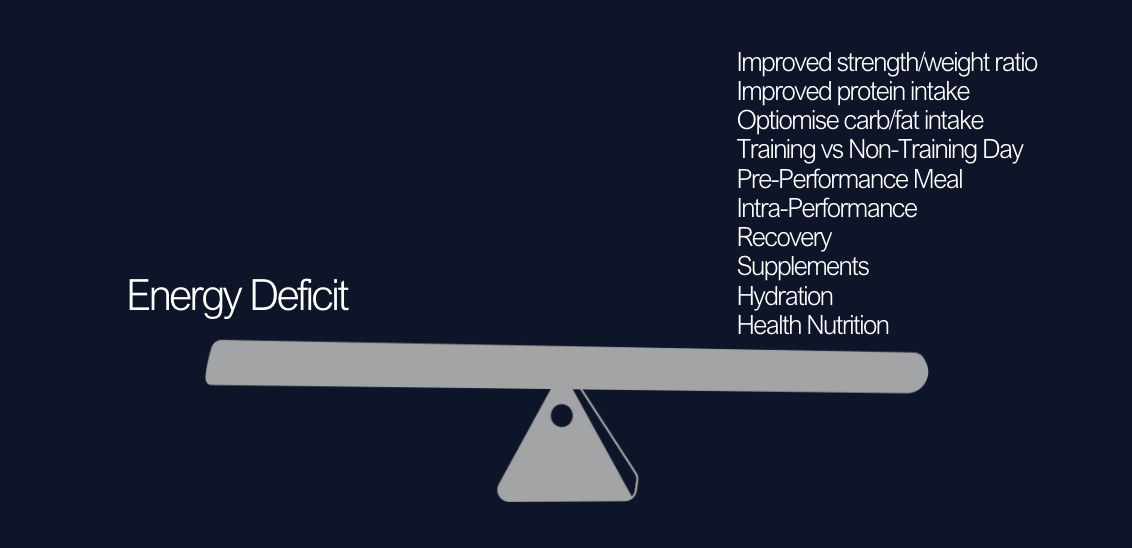
Of course, this has its limits.
For example, you could take calories so low that no amount of performance-enhancers will be able to balance it out.
And there may come a point in time where you make enough progress so that to go any further, you’d need to decide if you want to start sacrificing performance, or if it’s time to take a pause from fat-loss to prioritise performance.
Additionally, the extent to which each person can implement various nutrition strategies at once will vary, based on their experience, motivational levels, and lifestyle.
With all that said, some of the factors you might want to focus on for getting this balance right are:
1) Find Your Calorie Sweet-Spot
Aim for a rate of weight-loss you can sustain without sleep, mood, training quality, and hunger gradually deteriorating.
As a practical starting point, I’d recommend aiming for 0.5-1% of weight-loss per week.
2) Get Sufficient Protein
Protein helps preserve muscle mass, support recovery, and improve satiety.
About 2g per kg of bodyweight is a good target for most.
3) Prioritise Carbs over Fats
Carbohydrate is a key performance fuel.
With reduced calories, we want to ensure as many of those calories as possible (within reason) go towards that fuel.
4) Periodise Intake for Training vs. Rest Days
Again, with less total energy intake, we want to ensure more of that energy is placed where it’s needed most - that is on training days.
This keeps energy available when you need it, while still creating a weekly deficit.
5) Dial in Pre-, Intra-, and Post-Session Nutrition
Pre: carbs + protein 1 to 3 hours before.
Intra (when needed): carbs and fluids for longer or harder sessions.
Post: protein + carbs soon after to support recovery, especially when training again within 24 hours.
6) Push Fibre and Micronutrients up
Fibre helps with appetite control, inflammation management, and overall health.
We can help optimise this by increasing intake of fruit and vegetables, legumes, and higher-fibre carb choices (away from training if sensitive).
7) Add Supplements Once the Basics are Handled
Once your baseline is consistent, health and performance supplements can be a useful addition (chosen based on your needs, tolerance, and training demands).
Summary:
If you have tried to drop body fat before and felt performance suffering, it is not necessarily because the goal is impossible.
More likely, the deficit was too large, or you didn’t support the performance side of the scale strongly enough.
So as a 2-step framework, I recommend:
Creating a sustainable deficit.
Adding enough performance-supporting nutrition strategies to maintain performance, or even improve it.

Article Written By Conor O’Neill
P.s. You can find out more about Performance Nutrition Coaching HERE.