Training vs. Rest Day Nutrition: How to Adjust
Intuitively, it makes sense to eat more food on days you’re training hard compared to days when you’re not.
That is, you want to provide the body with more fuel for the days that need it most.
But if you’re trying to lose body fat or even just avoid unwanted weight gain, you’ll probably recognise a potential issue here.
You may find yourself asking, “If I increase my calorie intake on each training day, will that increase in average calorie intake across the week get in the way of my fat loss goal?”
If you were to simply increase your intake on training days and not make up for this by decreasing your intake elsewhere, the answer would likely be yes.
But if you were to make up for the increase on training days by decreasing your intake on non-training days, you’d be able to have more fuel in your body on the days it’s needed most, whilst still maintaining your daily average calorie intake over the course of a week.
As a result, you’d be able to achieve the same fat-loss progress as you would had you kept your intake constant across all days, but whilst performing at a higher level.
This approach is sometimes referred to as ‘calorie-cycling’ or ‘calorie-undulating’.
Defining Your Days
Before implementing this approach, it’s important to first decide what counts as a “training day” and a “non-training day”.
If you’re a field sport athlete (GAA, hurling, rugby, soccer, etc.) or a runner you can consider ‘training days’ as those days when you’re training intensely and for longer durations, e.g. with a team or doing tough running/cardio-based sessions alone.
You can then count ‘non-training days’ as those days where you’re not training at all, or where you’re doing gym sessions that, while perhaps tough, aren’t going to demand the same energy requirements as those of longer running sessions.
On the flip-side, if you’re going through an intense training block focussed on strength and hypertrophy, say in the off-season, the days you’re in the gym could become your training days, and the days you’re not training in the gym could be considered non-training days.
Who Should Use this Approach?
As with any nutritional strategy, the biggest factor isn’t what’s theoretically optimal - it’s what you can do consistently.
That means that even if this approach of calorie cycling is better on paper, if it makes your nutrition feel complicated and leads to inconsistency, a single daily calorie target will usually produce better results.
A practical way to apply this is to stick to one consistent daily calorie target for a period of 2-4 weeks, then transition towards having two separate intakes targets once you’ve built consistency with one.
When Can You Benefit From Calorie Cycling?
In a fat-loss phase, it’s often helpful because you can eat at around maintenance on harder days (supporting better training quality) and create a bigger deficit on easier days (driving fat loss over time).
In a maintenance phase, it can help you keep your average weekly calories the same while feeling better fuelled for training sessions, since you’re providing a surplus of calories on those days.
In an intentional weight gain phase, it’s usually less necessary because you already have extra calories available on both training and rest days, but if it works from you from a preference point of view, there isn’t likely to be a downside.
How Much Extra Should You Eat on Training Days?
A useful starting point for many athletes is to increase calories to about 10% above maintenance calories on training days.
This isn’t a set-in-stone number, and it’s primarily based on my own experience working with athletes and what makes sense logically.
For example, too small of an increase (e.g., 2%) would be unlikely to make any practical difference.
But too big of an increase (e.g., 25%) could force rest days to become uncomfortably low from a hunger perspective to compensate for the large increase on training days.
How Much Less Should You Eat on Non-Training Days?
The aim of decreasing your intake on non-training days is to off-set the extra weekly intake caused by the training day intake.
That is to say that if you add up the total extra weekly calorie intake from training days, you can then take away that extra intake from the non-training days.
If that seems complicated, bear in mind that this isn’t something you have to be calculating every day or week.
It’s something you calculate once to find your targets, and simply use those targets as guidelines for where your intake should be on each day.
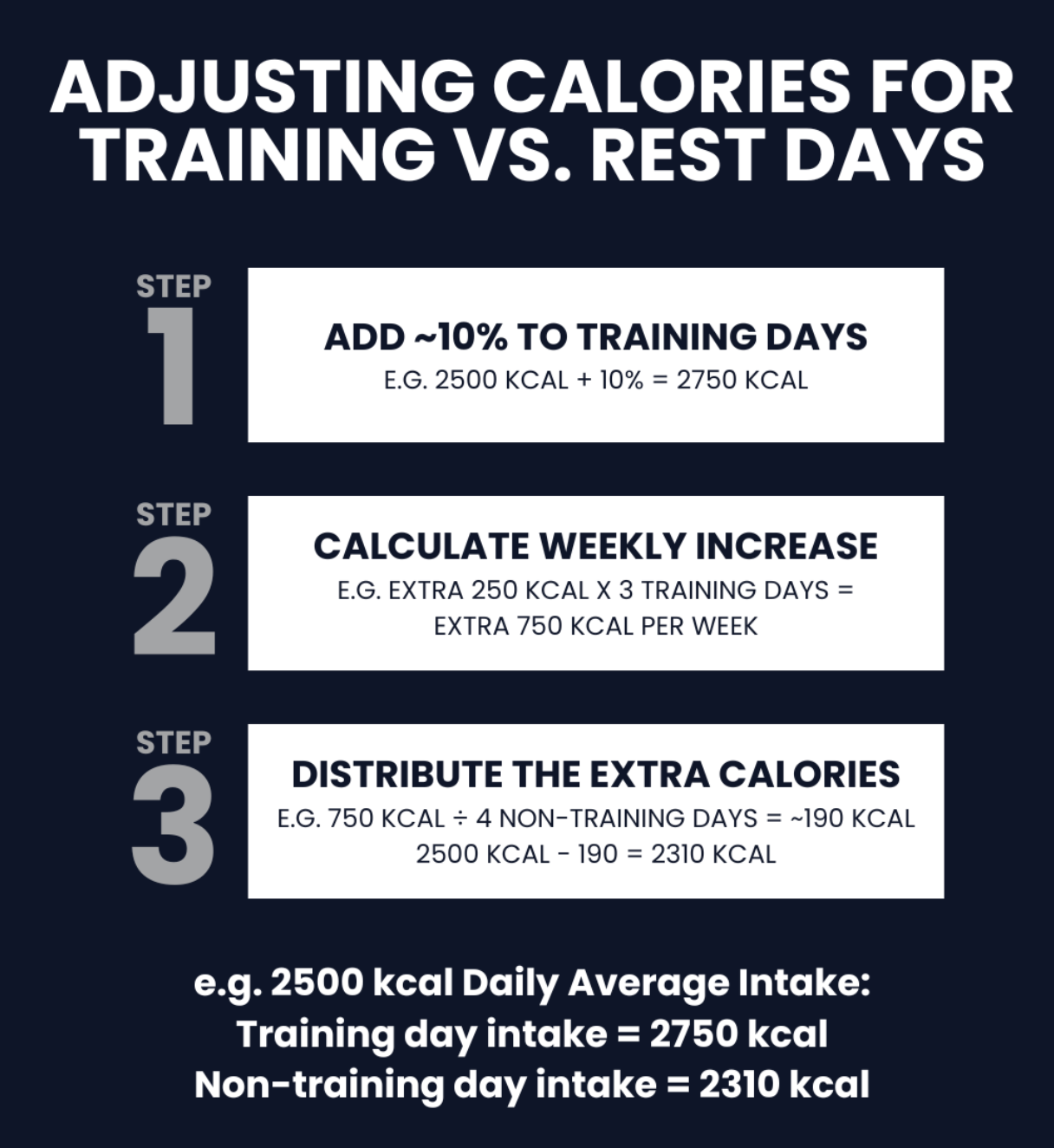
To give you an idea of what that could look like, here’s an example calculation:
Let’s say your current daily calroie target is 2500 kcal/day.
If you increase by 10% on training days, you training day target becomes ****2750 kcal.
That’s +250 kcal per training day.
If you train 3 days per week, that’s an extra weekly calories of 250 × 3 = 750 kcal
To keep your weekly average unchanged, you remove those calories from the other 4 days - 750 ÷ 4 = ~190 kcal per non-training day
So your targets become:
Training days: ~2750 kcal
Non-training days: ~2310 kcal
Adjusting Your Macronutrients
In most cases, the calorie difference between training and non-training days should come primarily from carbohydrates, not protein or fat.
This is because protein and fat requirements are primarily determined by your bodyweight or lean body mass, whereas carbohydrate requirements are generally based on activity levels.
For that reason, it makes sense that this is the macronutrient to change for training versus non-training days is carbohydrate.
As a final reminder, many athletes make great progress and feel great with one consistent daily calorie target, so consider calorie cycling an optional upgrade, not a requirement.
If you’re consistent with the basics and you want better fuel for key sessions whilst adapting your weekly intake to suit your body composition goals, calorie cycling can be a simple, effective next step.

Article Written By Conor O’Neill
P.s. You can find out more about Performance Nutrition Coaching HERE.