The Performance Nutrition Pyramid
In the social-media age, you can end up feeling completely overwhelmed by the vast amount of nutrition information out there, not knowing what’s important and what’s overhyped.
It’s also become difficult to distinguish between advice that is confidently delivered but incorrect, and advice that’s aligned with the scientific evidence.
As an athlete, this difficulty is increased by the fact that nutritional requirements are often different for you than they are for the average person.
For that reason, I’ve aimed to create a framework that:
Is ordered by what will give the biggest return on your efforts, allowing you to build the foundations and work towards more advanced elements, saving you from wasting time and effort on low-return strategies.
Is evidence-based, giving you confidence that you’re operating from sound principles that have been proven to be effective.
Is based around the unique needs and goals of athletes, so you can achieve not only your health and body composition goals, but also those related to your athletic performance.
This framework takes the form of a pyramid that includes four tiers, each of which builds on the one below.
Of course, you don’t need to fully master one tier before implementing some of the others, but it is useful to think about prioritising those lower on the pyramid over those higher, knowing there is a bigger potential return on your effort from working on the more foundational elements.
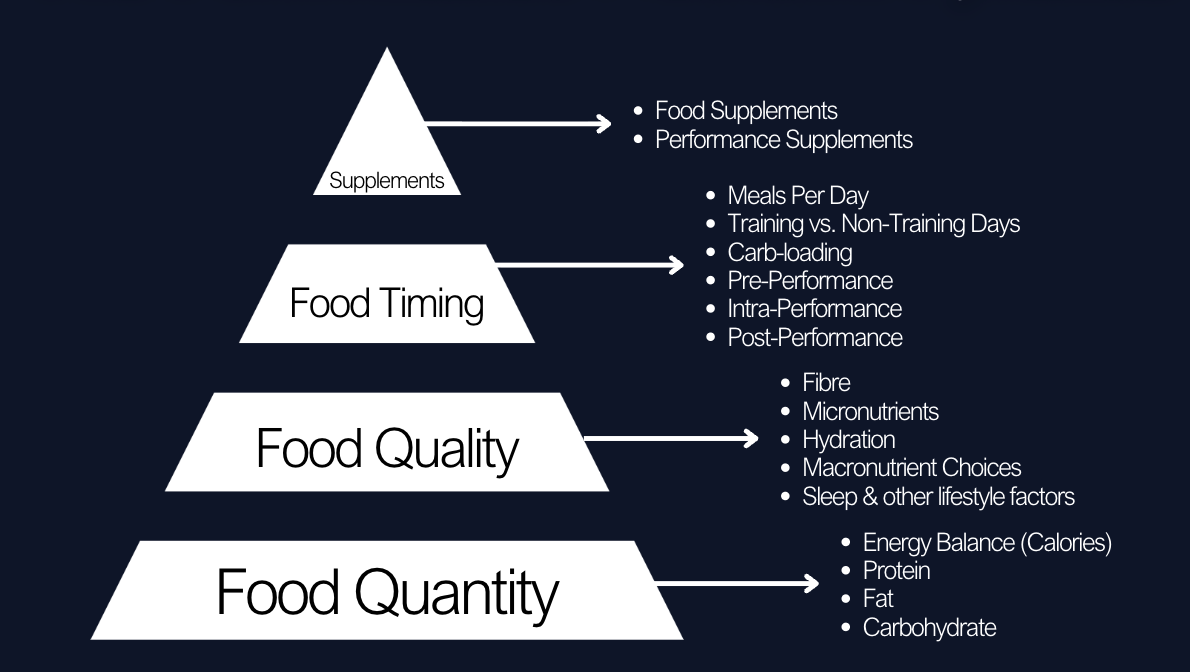
The pyramid is structured as follows:
Tier 1: Food Quantity
1.1 Energy Balance (Calories)
Overall energy intake is the primary driver of both fuelling and body composition outcomes.
That is to say, no matter how “healthy” your diet is, if you’re not eating enough, fuelling and recovery will be compromised, and if you’re eating too much, you will gain unwanted bodyweight.
The aim is to find the balance between those extremes, where you’re giving the body what it needs to perform, whilst still having your body composition be aligned with your goals.
1.2 Protein
Protein supports recovery, tissue repair, and training adaptation, and adequate protein intake helps support lean mass retention/gain during both performance and body composition phases.
The aim is to have enough to achieve these outcomes without having so much as to displace other nutrients that might be more beneficial once your protein intake is adequate.
1.3 Fat
Dietary fat is essential for health and performance-related processes, including hormone production, nutrient absorption, cell membrane function, brain and nervous system health, and inflammation regulation.
Fat intake needs to be sufficient to support these outcomes whilst still fitting within our overall energy needs.
1.4 Carbohydrate
Carbohydrate is the primary fuel for higher-intensity training and competition.
For optimal performance, it’s important to address ongoing carbohydrate, how that changes based on daily and weekly training load, and how to strategically place carbohydrate intake around training and competition.
Tier 2: Food Quality
2.1 Fibre
Fibre plays a key role in gut health, digestion, appetite regulation, and long-term health.
Eating adequate fibre whilst taking into account timing around training and competition is key to getting these benefits whilst avoiding potential downsides.
2.2 Micronutrients
Vitamins, minerals, and phytonutrients support performance-related processes (energy production, oxygen transport, muscle function, bone health, and recovery), and deficiencies can, often without you realising, limit performance.
2.3 Hydration
Hydration status influences performance, largely through its effects on blood volume, thermoregulation, and perceived effort.
Ensuring adequate hydration can help you maintain performance and decision-making, reduce fatigue, and support recovery, especially in hot environments or long sessions.
2.4 Macronutrient Choices
Macronutrient choices are about the quality of the foods you use to hit your macros, and different food choices can affect digestion, satiety, micronutrient intake, and therefore how you feel and perform.
2.5 Sleep & Other Lifestyle Factors
Whilst not strictly in the realm of nutrition, sleep and lifestyle (stress, routines, alcohol, daily movement) affect appetite, decision-making, recovery, and the consistency needed to make nutrition work.
Addressing these areas can not only make it easier to stick to your nutrition goals, but can also bring benefits in and of themselves.
Tier 3: Food Timing
3.1 Meals Per Day
The frequency and distribution of your meals and snacks can influence energy availability, protein distribution, appetite, and practical consistency when your schedule gets busy.
3.2 Training vs Non-Training Days
Matching intake to training demands helps align higher-energy intake with harder days, which can support performance, recovery, and body composition outcomes.
3.3 Carb-Loading
Carb-loading increases glycogen stores, which can increase the energy available when it matters most.
3.4 Pre-Performance Nutrition
Pre-performance nutrition helps you start activity fuelled and hydrated while keeping digestion comfortable and predictable.
3.5 Intra-Performance Nutrition
During-session fuelling can matter in longer or more intense work, providing extra fuel when fuel demands are higher.
3.6 Post-Performance Nutrition
Recovery nutrition can help ensure you’re ready for you next session by promoting repair, replenishment, and rehydration.
Tier 4: Supplements
4.1 Food Supplements
Food supplements are used mainly for convenience, or to help meet nutrition needs more reliably when time, appetite, or access to food is limited.
4.2 Performance Supplements
Performance supplements are intended to improve performance directly, and their usefulness depends on sport demands, individual response, and practical trade-offs.
How to Use the Pyramid
The pyramid is a simple tool for two things:
Firstly, it can be used to give you an idea of where to start.
That is, start with the foundational elements, getting consistent with those, then adding in elements further up the pyramid as you go.
Secondly, it can be used as a framework for ranking the nutrition advice you’re hearing (on social media, from a teammate, from a podcast).
This can allow you to decide whether it’s something worth focussing on now, waiting until you have other elements in place, or ignoring altogether.

Article Written By Conor O’Neill
P.s. You can find out more about Performance Nutrition Coaching HERE.